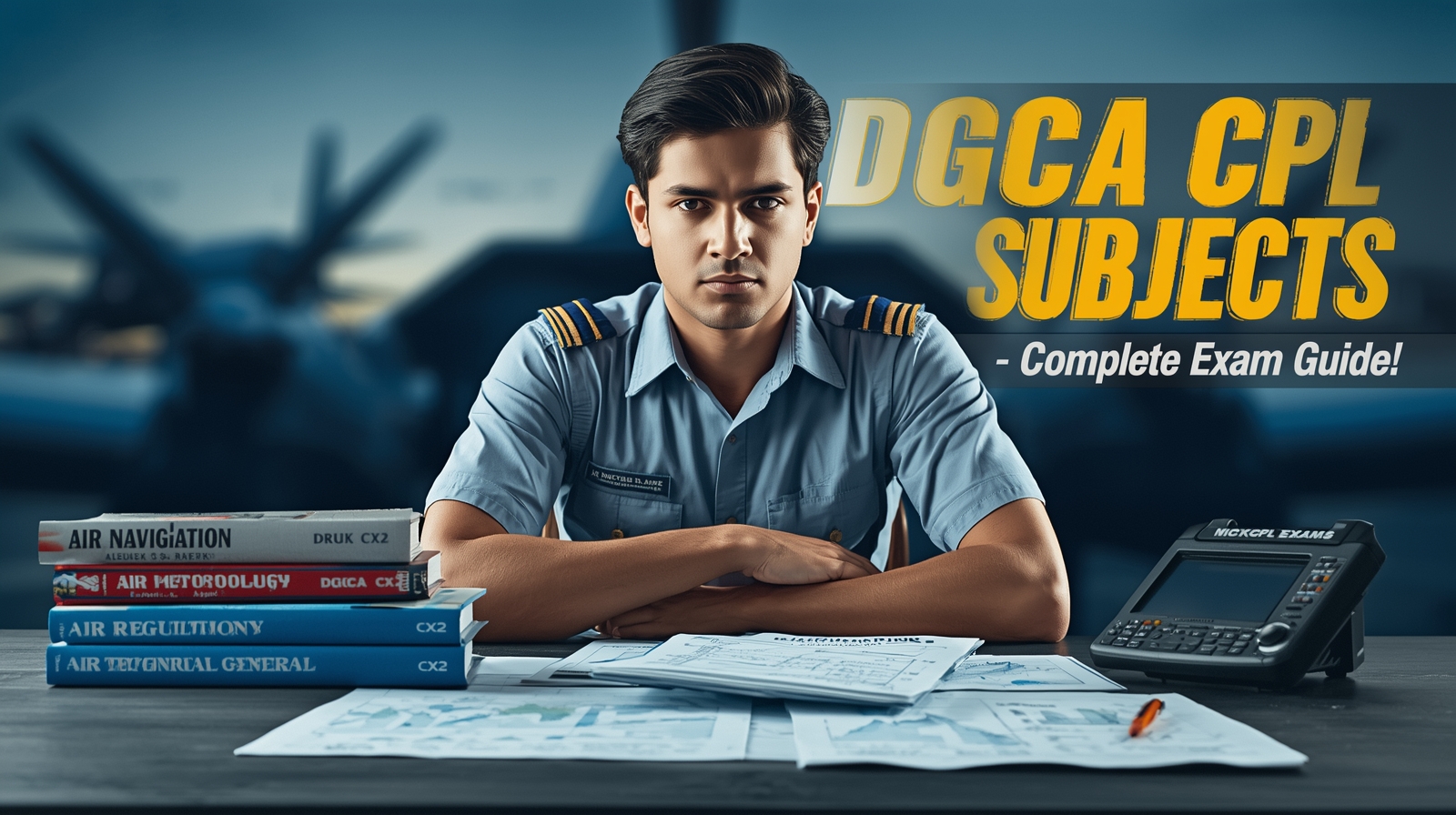
DGCA CPL Subjects – Complete Guide (Syllabus, Books, Exam Pattern & Passing Marks)
If you’re planning to become a Commercial Pilot in India, clearing the DGCA CPL theory exams is one of the first and most important steps. This guide covers every subject, the syllabus, the best books to study from, the exam duration, the number of questions, and the passing criteria — everything explained simply for student pilots.
CPL Theory Subjects under DGCA
To obtain a Commercial Pilot Licence in India, you must clear the following six DGCA theory papers, along with the RTR(A) exam conducted by WPC.
Air Navigation
Meteorology
Air Regulations
Technical General
Technical Specific
RTR(A) – Radio Telephony (Aero)
These form the core knowledge required for safe flight operations and future airline preparation.
1. Air Navigation – Syllabus, Books & Exam Pattern
Air Navigation is one of the most detailed DGCA subjects. The syllabus includes flight planning, time calculations (UTC, IST, LMT), great circle and rhumb line navigation, position fixing, radio navigation aids like VOR, DME, ADF, ILS, and the use of aviation charts. Students also learn drift correction, ETA/ETD calculations, fuel planning, and basic instrument navigation.
For this subject, the best books are RK Bali (Air Navigation), Oxford Navigation, and Keith Williams.. Ground school notes are also highly recommended.
The exam usually has around 100 multiple-choice questions, the duration is three hours, and the passing mark is 70%. Since there is no negative marking, students should attempt all questions.
CX -3 and scientific calculator is allowed
2. Aviation Meteorology – Syllabus, Books & Exam Details
Meteorology covers the atmosphere, pressure systems, winds, temperature variations, cloud formation, stability and instability, fronts, jet streams, thunderstorms, icing, fog, turbulence, and aviation weather forecasting. Students also learn how to interpret METARs, TAFs, wind charts, significant weather charts, and upper-air charts.
Recommended books include I.C Joshi, Oxford and notes from reputable DGCA ground schools.
The exam generally contains 50 MCQs, and the time given is two hours. The student must score 70% or more to pass. This exam is theory-heavy but scoring if concepts are clear.
Scientific calculator not allowed
3. Air Regulations – Syllabus, Books & Exam Pattern
Air Regulations covers Conventions, Indian aviation laws, ICAO rules, airspace classification, pilot responsibilities, licensing rules, flight rules, ATC procedures, aircraft registration, enforcement procedures, emergencies, and search and rescue.
The best reference is RK Bali Air Regulations, along with DGCA’s own CARs (Civil Aviation Requirements) and mock test guides.
The exam contains 50 MCQs, lasts two hours, and requires a minimum of 70% for passing. This is considered one of the crucial DGCA subjects if studied correctly
4. Technical General
Technical General includes aerodynamics, forces acting on an aircraft, stability, aircraft structures, systems (fuel, electrical, hydraulics, environmental, avionics), electrical piston and turbine engines and propellers.
Top books include Oxford, Electrics, Airframes and Systems, Powerplant & Principle of Flights
The exam generally has about 100 questions, with a duration of three hours, and the passing mark is 70%. This is one of the more detailed subjects, requiring consistent study and conceptual understanding
5. Technical Specific (Aircraft Type Specific)
Technical Specific is based on the specific aircraft you have flown during your CPL training. The syllabus includes that aircraft’s systems, performance charts, operating limitations, weight and balance, fuel system, emergency procedures, and avionics.
The only book required is the aircraft’s POH (Pilot Operating Handbook) or AFM (Aircraft Flight Manual). Ground school modules for the specific aircraft type are also important.
The exam usually contains 50 questions, lasts two hours, and passing requires 70% or higher.
6. RTR(A) – Radio Telephony
RTR(A) is now conducted by DGCA. The exam checks your radio communication skills, aviation phraseology, emergency communication, and ability to handle real-time ATC situations. It includes a written examination, followed by a viva and practical test.
Study material includes WPC’s RTR syllabus, aviation communication manuals, and plenty of practice of standard phraseology.
Exam Validity & Attempt Rules
Once you pass a DGCA subject, your result remains valid for 5 years toward CPL issue. Students may retake any failed subject as many times as needed because there is no attempt limit. Since DGCA exams do not have negative marking, it is always advisable to attempt every question.
Preparation Strategy for DGCA CPL Exams
Aviation subjects require both understanding and practice. Navigation and Technical General need regular numerical practice, while Regulations and Meteorology require conceptual clarity. Students are advised to join a good ground school, follow a structured timetable, and solve plenty of mock tests.
Always revise RK Bali, Jeppesen, and Oxford materials thoroughly. Mock tests help with time management, and reviewing DGCA CARs is essential for the Regulations paper. For RTR(A), students should practice listening and speaking daily using sample ATC scenarios.
Final Thoughts
The DGCA CPL exams may seem challenging at first, but with the right books, a disciplined study plan, and consistent practice, clearing all six subjects becomes manageable. Aim for a strong foundation instead of just passing — this theoretical knowledge directly contributes to safe flying and future airline success.
Link for DGCA examination guidelines: https://www.pariksha.dgca.gov.in/PDFViewer.jsp?pdf=518508