What Is Instrument Rating (IR)? A Complete DGCA Guide for Student Pilots (2025 Updated)
An Instrument Rating (IR) is one of the most important add-ons to your flying career. It allows a pilot to fly safely using only instruments, without outside visual reference—crucial for airline operations, bad weather, and IFR flight. If you plan to join an airline or build a strong aviation foundation, getting your IR early is a smart decision.
This guide explains IR requirements, DGCA rules, flight hour requirements, simulator allowances, cross-country requirements, and validity criteria — everything simplified for student pilots in India.
What Is Instrument Rating?
An Instrument Rating authorizes a pilot to fly under Instrument Flight Rules (IFR). This means navigating, controlling, and operating the aircraft using cockpit instruments only. It trains you to handle clouds, bad visibility, and complex airspace professionally.
IR is mandatory for anyone aiming for:
✔ Airline jobs
✔ Multi-engine IFR operations
✔ Advanced flying roles
✔ Safer all-weather flying
DGCA Requirements for Instrument Rating (2025 Latest)
DGCA has clear requirements for flight time, instrument time, simulator use, and cross-country experience. Here’s everything you must know.
1. Instrument Flying Requirement – 50 Hours Total
DGCA requires 40 hours of instrument time.
Breakup of Instrument Hours
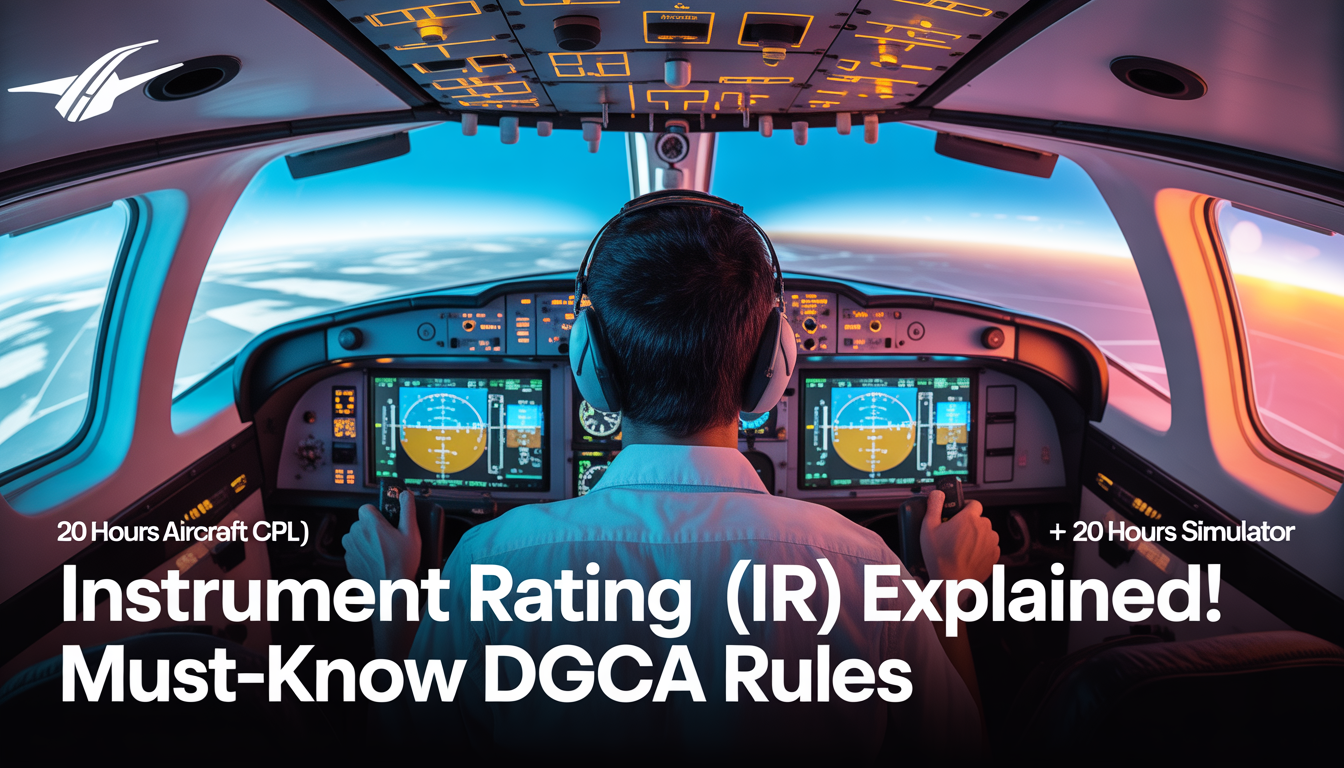
Minimum 20 hours must be done on an actual aircraft.
Remaining 20 hours can be completed on an approved simulator.
Using a simulator for 20 hours makes IR training far more cost-efficient, while still meeting DGCA standards.
Recent Instrument Hours Requirement
Minimum 5 hours of instrument time must be completed within 6 months before applying for the IR.
2. Cross-Country Requirement for IR
To apply for Instrument Rating:
Minimum 40 Hours PIC Cross-Country (Mandatory)
You must complete not less than 40 hours of cross-country flight time as Pilot-in-Command (PIC).
300 NM Cross-Country Flight Requirement
Your PIC cross-country record must include:
One cross-country flight of at least 300 nautical miles,
With full-stop landings at two different aerodromes.
Important DGCA Rule (Most Students Miss This!)
For ANY cross-country to count:
The distance between point of departure and destination or overflown point MUST be more than 100 NM.
Anything less than 100 NM will not be counted by DGCA.
This is one of the most common reasons applications get delayed — so plan your PIC flights properly.

Why Instrument Rating Is So Important
IR training builds critical skills like:
Handling low-visibility conditions
Navigating using instruments alone
Understanding IFR procedures
Conducting precision/non-precision approaches
Operating safely in controlled airspace
Airlines give higher preference to CPL holders with strong IR training because it shows discipline, precision, and confidence.
Best Time to Get Your Instrument Rating
You should complete your IR immediately after CPL or during time-building, because:
Your instrument flying skills stay fresh
Your simulator hours stay valid
IR is required for airline entrance exams and Type Rating
Delaying IR increases cost and effort
Final Thoughts
Instrument Rating is one of the most valuable qualifications in your flying journey. By planning your cross-country flights correctly and utilizing simulators effectively, you can complete your IR efficiently and economically.
A well-completed IR not only improves your safety and confidence but also brings you a step closer to airline flying.