New DGCA RTR Rules 2025 Explained — Simple Guide for Student Pilots
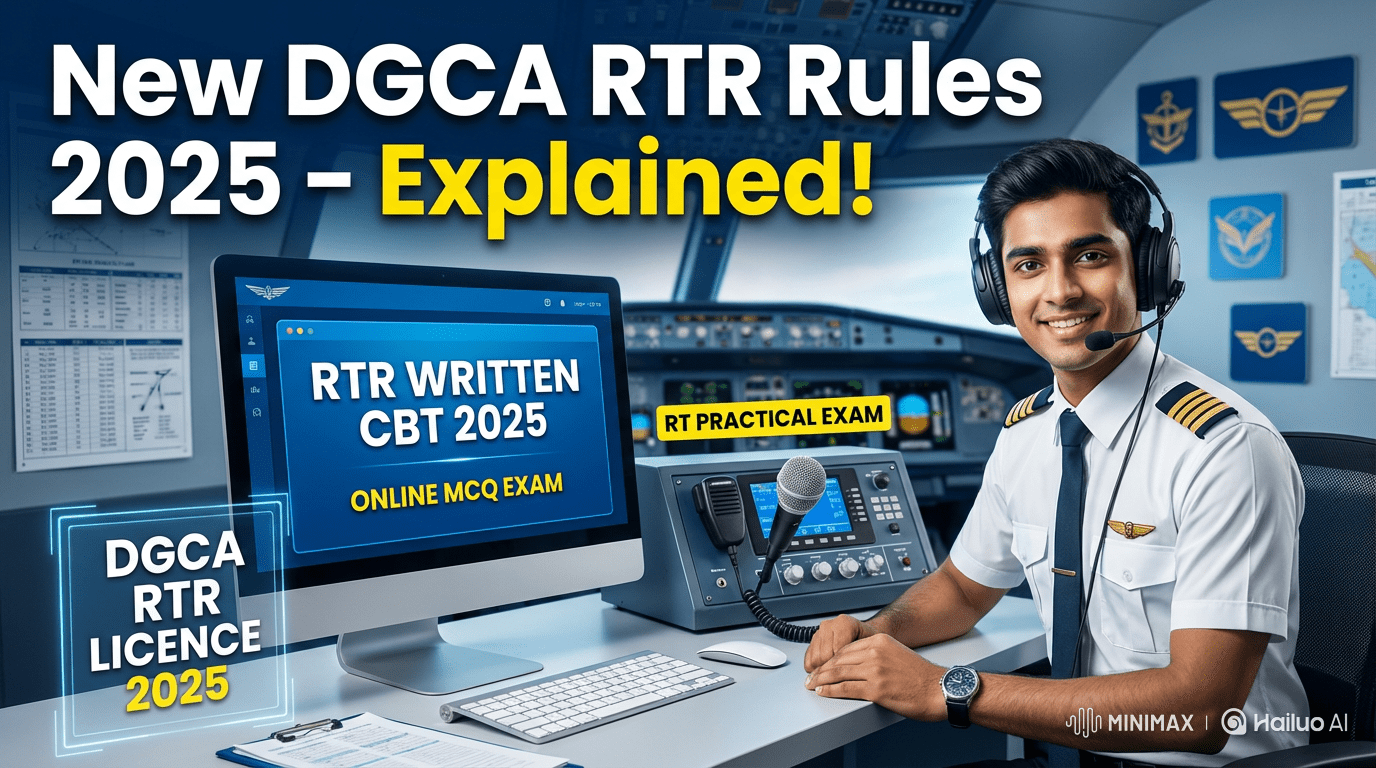
DGCA has officially released the new RTR (Radio Telephone Operator Restricted) Rules 2025, and these rules completely redefine how student pilots will appear for the RTR Written Exam, Practical Exam, Certification & Licence.
Earlier, RTR(A) was handled by the WPC wing of the Ministry of Communications.
But from 2025 onwards, RTR for pilots in India is fully regulated, conducted, assessed and issued by DGCA.
This blog explains the new rules in simple language, so every student pilot understands exactly what has changed and how to clear RTR in 2025.
1. What Has Changed in RTR 2025?
Based on the PDF you uploaded:
The 2025 rules give DGCA full authority to conduct:
Earlier, the exam was mainly oral + practical, conducted by WPC. Now DGCA has split it clearly:
Candidates must have a DGCA Computer Number to appear for RTR Written & Practical.
Including:
✔ DGCA now controls the complete RTR exam & licensing
The 2025 rules give DGCA full authority to conduct:
- Written exam
- Practical exam
- Certification
- RTR Licence issue
✔ Written + Practical Exam structure introduced
Earlier, the exam was mainly oral + practical, conducted by WPC. Now DGCA has split it clearly:
- Part A — Written exam (MCQ based)
- Part B — Practical exam (simulated RT environment)
✔ Computer Number is mandatory
Candidates must have a DGCA Computer Number to appear for RTR Written & Practical.
✔ All applications to be made on eGCA
Including:
- Exemption requests
- Written exam
- Practical exam
- RTR Licence
✔ New pass marks & validity
- Written: 70% passing, valid for 3 years
2. Eligibility & Exemptions (Important for CPL Students)
DGCA allows some candidates to skip the written exam.
✔ Who is exempt from RTR Written Exam?
According to DGCA Rules 2025, the following can skip the written exam:
- Indian Air Force, Navy, Army & Coast Guard pilots with 1500 hours experience
- Holders of valid old WPC RTR licence (1954 Rules)
- Pilots holding valid FRTOL or equivalent licence from Commonwealth nations or Philippines
👉 These candidates can directly apply for the Practical Exam through eGCA.
✔ Exemption validity
Valid for 3 years
3. RTR Written Exam (NEW 2025 Pattern)
✔ Format
- Online Computer-Based Test (CBT)
- 50 MCQs
- Language: English
✔ Pass Mark
- 70%
✔ Syllabus Includes:
- Radiotelephony regulations
- ICAO Annex 10 procedures
- Q-codes & Phraseology
- Distress & Urgency Communication
- Meteorology codes
- Aircraft radio equipment regulations
- FIRs & frequencies
- General RT procedures
- Aerodrome, Approach & Area Control communication
- Emergency & failure procedures
- Navigation aids & radio principles
This syllabus is now structured and clearly defined, unlike the older WPC system.
4. RTR Practical Exam (NEW DGCA Format)
✔ Eligibility
You can appear for the Practical exam only if:
- You passed the written exam, OR
- You are exempted from the written exam
✔ How to Apply
Through eGCA Portal:
- Register/login
- Select available practical exam slot
- Pay fees
- Download your admit card (available 3 days before exam)
✔ Exam Duration
- 30 minutes approx.
✔ What Happens in the Practical Exam?
DGCA uses a simulated radiotelephony environment, testing:
- RT communication for all flight phases
- Ability to send & receive RT messages
- Knowledge of emergency procedures
- Familiarity with regulations & aviation communication rules
- Provisions for aeronautical mobile service & navigation
✔ Passing Marks
- 50%
✔ Attempts Allowed
- 3 attempts within written exam validity
If all 3 attempts fail → candidate must reappear for written exam
5. Issue of RTR Certificate & Licence (New Process)
Once you pass the Written + Practical, you must:
- Pay the RTR Licence fee on eGCA
- Submit your application online
- DGCA verifies your documents
Your RTR Certificate & Licence is issued digitally on eGCA
6. Validity Extension (For Older Pilots)
DGCA allows candidates above 80 years, or those seeking renewal, to extend validity if:
- They show 3 months’ experience in an aeromobile service station in the last year
Renewal will be done yearly.
7. DGCA Requirements for RTR Training Organisations
The new rules also define the standards for RT training centres (RTTO):
They must provide:
- Approved instructors
- ATC–Pilot communication lab
- Flight simulation-based RT training
- Voice-recording system
- ICAO Doc 9432–compliant environment
- Quality assurance system
8. What This Means for Student Pilots (Simple Summary)
✔ RTR exam is now easier, structured & DGCA-managed
✔ No more WPC exam confusion
✔ Written exam is now MCQ, not oral
✔ Practical exam is simulated and aviation-focused
✔ Licensing is now fully digital on eGCA
✔ Clear syllabus + clear pass marks
This is a big improvement for CPL/ATPL aspirants in India.
Conclusion
The DGCA RTR Rules 2025 bring long-awaited clarity and simplicity to the Indian pilot licensing system. With computer-based written exams, structured practical tests, exemptions for experienced pilots, and end-to-end processing through eGCA, the new RTR framework is modern, transparent and student-friendly.
For every student pilot preparing for CPL/ATPL, this is the best time to begin RTR preparation.