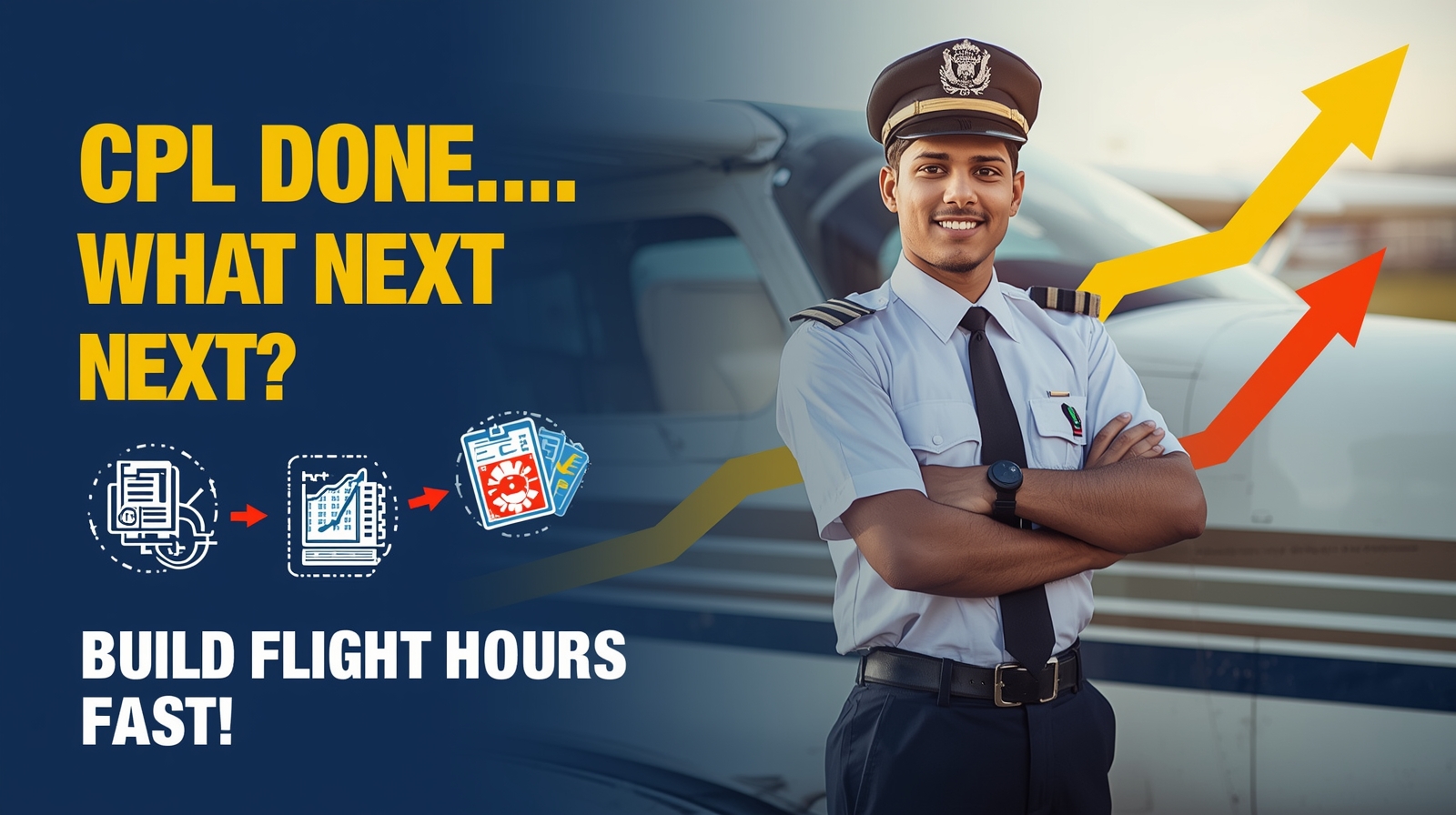
CPL Done… What Next? Top Methods to Build Flying Hours Quickly & Affordably (India Guide)
So you’ve finally earned your Commercial Pilot Licence (CPL) — congratulations!
But the journey doesn’t stop here. To qualify for airline applications and stay legally “current,” pilots must keep flying regularly and build sufficient hours, especially PIC (Pilot-in-Command) time.
This blog explains the most effective, affordable, and realistic ways to build flying hours in India (and abroad) after getting your CPL.
1. Rent an Aircraft at a Flying Club (Most Common Option)
After CPL, the simplest way to build hours is renting a single-engine aircraft at your flying school or local flying clubs.
Rates usually range between ₹10,000 to ₹18,000 per hour depending on the aircraft model, state, and fuel cost.
If you can join with classmates and plan structured cross-countries, you save time and cost.
2. Join Flight Schools as a Safety Pilot or Co-Pilot
Many flight schools allow CPL holders to assist instructors during ferry flights, repositioning flights, or long navigation exercises.
This helps you build hours at reduced cost — sometimes ₹5,000–₹8,000 per hour, depending on the school.
3. Time-Building Packages in India
Some academies offer bulk flying hour packages where booking 50–100 hours together gives up to 10–20% discount.
Great for building PIC hours fast, especially if you need 200 hours total for airline exams or interviews.
4. Hour Building Abroad (USA, South Africa, Philippines)
Many Indian pilots go abroad because hour-building is cheaper and weather is better.
Typical cost in the USA ranges from ₹7,000–₹12,000 per hour depending on the state and aircraft.
Make sure the flying school abroad is DGCA-approved for logbook acceptance.
5. Become a Flight Instructor (Most Cost-Effective Long-Term Method)
If you enjoy teaching, becoming an FI is one of the best ways to build hours — and get paid for flying.
Instructor training costs around ₹8–12 lakh, but once hired, you can build hundreds of hours, which airlines value highly.
6. Apply for Ferry Flights (Great for Real-World Experience)
Ferry flights involve repositioning an aircraft from one airfield to another.
Some schools charge minimal or shared flying rates for these flights.
You gain tons of navigation experience and long-route exposure.
7. Join Glider Clubs or Microlight Clubs
-
Simulator training is one of the smartest investments a student pilot can make.
It improves your learning curve, increases your confidence, sharpens your decision making, and reduces your overall flying cost.Before you begin your CPL flying journey — whether in India or abroad — 10–20 hours of sim training can save you money, time, and stress.
8. Group Flying With Friends
Partnering with two or more CPL holders helps reduce hourly cost since you can split navigation task planning, rentals, fuel costs, and landing fees.
This is common among pilots who want to complete cross-country requirements efficiently.
9. Volunteer at Flying Clubs or Tow-Plane Operations
9. Volunteer at Flying Clubs or Tow-Plane Operations
Some aviation clubs let CPL holders assist with ground briefings, towing operations, and admin work, which can give you discounted rates for flying hours.
Not always guaranteed, but worth exploring
9. Volunteer at Flying Clubs or Tow-Plane Operations
9. Volunteer at Flying Clubs or Tow-Plane Operations
• Prioritize cross-country flights over local circuits — they build real experience.
• Avoid long gaps; fly at least once every 60–90 days to stay current.
• Maintain a clean, updated logbook — airlines check this carefully.
• Don’t rush; build hours gradually with focused learning.
• Choose aircraft with lower rental rates (152, 172, PA-28) for maximum savings.
Final Thoughts
Building flying hours after CPL can be expensive, but with the right strategy, you can do it efficiently and affordably.
Whether you rent aircraft, instruct, fly abroad, or join ferry operations — consistency is key.
Every flight hour is a step closer to your airline cockpit dream.